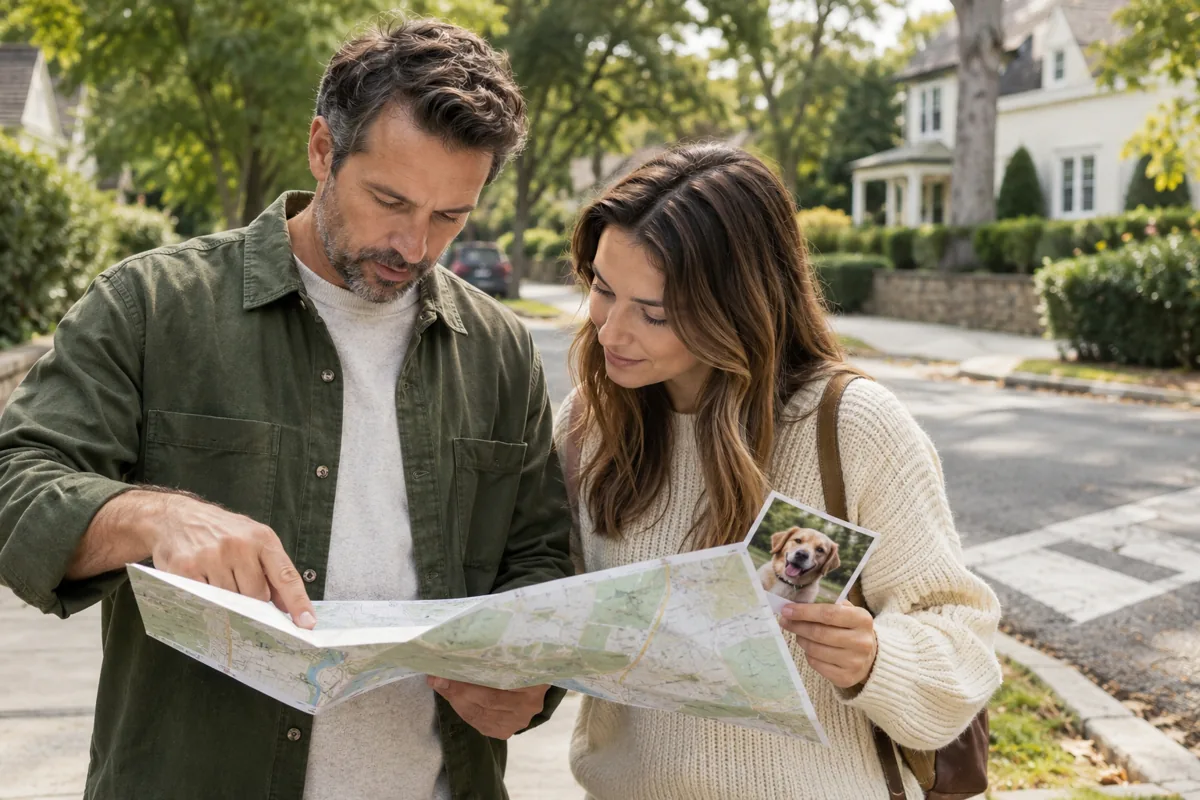
Start with a safe check of your home and the last confirmed location, report your dog missing to the relevant local shelter or animal services agency, and give neighbors a clear photo with instructions to report sightings rather than chase. Keep one record of what you know. A coordinated search is easier to adjust than a series of rushed guesses.
This guide helps you organize people, information, and follow-up. It cannot predict where an individual dog will go or replace local recovery assistance. If a dog is injured, on a busy road, or creating an immediate safety hazard, contact the appropriate local service before trying to intervene.
Establish the last confirmed location
Check inside the home, including closed rooms and spaces a dog could enter unnoticed. Ask everyone who handled the dog when they last actually saw them. A person remembering a bark is different from someone watching the dog leave a gate. Record that distinction instead of turning an assumption into a fact.
Write the date, time, street or landmark, and direction of movement. Note whether the dog wore a collar, harness, or leash. Save a recent full-body photo and a close view of the face. If the coat has recently been clipped, use a current image; an older fluffy portrait may confuse someone who has just seen a short-haired dog.
Do not spend an hour polishing the description before beginning useful outreach. A short accurate notice can be improved later. For a time-based task list, use our first-day checklist.
Give the search a simple structure
Choose a coordinator who can answer calls and maintain the log. Another adult can check nearby safe public areas. A third person, if available, can handle shelter contacts and permission for flyers. People may take more than one role, but each task should have an owner so nobody assumes somebody else has done it.
Start a shared notebook or document with four headings: confirmed facts, incoming reports, completed tasks, and next actions. Put uncertain reports in their own category. This makes it possible to change the plan when useful information arrives without losing track of routine follow-up.
Tell helpers how to reach the coordinator. Ask them to send a location and time privately before sharing a sighting widely. A large group converging on the same spot can create noise, traffic, and conflicting instructions. Ask children to help with supervised indoor tasks, such as organizing printed notices, rather than searching alone.
Search safely and ask specific questions
Look around the last confirmed area where you can lawfully go. Ask property owners to check enclosed spaces, garages, or yards themselves, or request permission to enter. Do not trespass, climb fences, enter construction sites, or step into traffic. Carry a charged phone and tell someone where you are going.
Ask a neighbor, “Did you see a loose tan dog near this corner after lunch?” rather than simply “Have you seen my dog?” Show the photo. If they have a camera, ask whether they can check the relevant time window. Do not demand access to recordings or post private footage without permission.
Humane World for Animals recommends telling people to report a sighting without chasing the dog. Read its lost-dog guidance. In practice, give helpers the same short instruction every time: observe from safety, record details, and call. Avoid treating a frightened dog's response as disobedience.
Contact the agency that serves the location
Find the official municipal or county animal services website for the area where the dog disappeared. A shelter with a nearby address may not be the agency receiving animals from that particular neighborhood. Ask who handles found dogs there, how to file a report, and which other facilities you should contact.
Provide a photo, description, last confirmed location, and a reliable contact number. Keep the report reference and the name of the facility. Ask about viewing found-animal listings, checking in person, and the documents needed to reclaim a dog. Procedures, fees, and holding periods vary; do not assume another city's instructions apply.
Schedule follow-up rather than relying on one phone call. Staff may receive a dog after your initial inquiry. Look at photos instead of filtering only by a breed label, because descriptions can differ. If you cannot travel, ask the facility what remote checking options are available.
Put identification information to work
Locate your dog's microchip paperwork or ask your veterinary practice where the number is recorded. Contact the registry using its official contact details and confirm that the phone number and email on file are current. Ask what lost-pet notification steps it offers. Do not post the full chip number in an unrestricted public notice.
A microchip needs to be scanned; it does not show a live location. AAHA explains this distinction in its pet microchipping FAQs. A collar-mounted tracker is a separate device, and an old location reading should be recorded with its timestamp rather than treated as proof of where the dog is now.
Prepare proof of ownership privately: veterinary records, adoption paperwork, and older photographs. Keep copies available for the shelter or a verified finder. There is no need to send your full address, identification document, or payment information to an unknown caller merely because they claim to have found your dog.
Make one notice people can use
A good notice has a clear photo, a short description, the approximate last-seen area and date, and a contact method. Include “DO NOT CHASE — REPORT SIGHTINGS” when appropriate. Use our flyer design guide for a copyable template and distribution plan.
Keep the main facts consistent across printouts and community posts. Ask group administrators about their rules before posting repeatedly. A useful update contains new information or a clear current status. Reposting the same message in dozens of unrelated groups can make it harder to track real leads.
Keep one distinctive detail private to help evaluate a finder claim. That could be an unusual marking not obvious in the public photo. It is only one check, not conclusive proof. Ask for a current photo and independently verify any claimed shelter or veterinary business through its published number.
Evaluate sightings before redirecting everyone
Ask when the person saw the dog, where they were standing, which way the dog moved, and whether they have a photo. Note the time of the sighting separately from the time the message arrived. A report sent at dinner may describe something seen that morning.
For example, two messages may refer to one dog seen near a school at different times. Mark each report on your map without assuming they are independent confirmation. Compare visible markings, size, and equipment. A similar color alone is not enough to rule in or rule out a lead.
If the dog is repeatedly seen but avoids people, stop organizing pursuit. Share the pattern with animal services or an experienced local recovery group. Our frightened-dog guide explains how to preserve useful information while giving the animal space.
Review the plan when the initial search changes
At the end of a search session, note which areas were checked and what remains uncertain. Empty streets do not prove a dog has left the neighborhood. Broaden outreach thoughtfully, revisit official listings, and follow concrete leads. Get help rotating tasks so the coordinator can eat, rest, and keep the phone available.
If the dog is found, confirm identity and arrange a safe handover through a suitable local channel. Seek veterinary advice about injuries, illness, or concerning behavior. Update every listing, notify contacted facilities, and remove posters where possible. Then record how the escape happened so the next change addresses that specific weakness.
Your next action
Open a notebook and write the last confirmed place and time, one working contact number, and the agency responsible for that area. Assign the next three tasks. You do not need a perfect plan before starting; you need an accurate shared starting point and a safe way to respond to new information.